Eco-perimeter commercial pest maintenance prioritizes facility exterior envelopes, stopping insects and rodents before they breach sensitive interior zones like production floors, stockrooms, or customer areas. In…
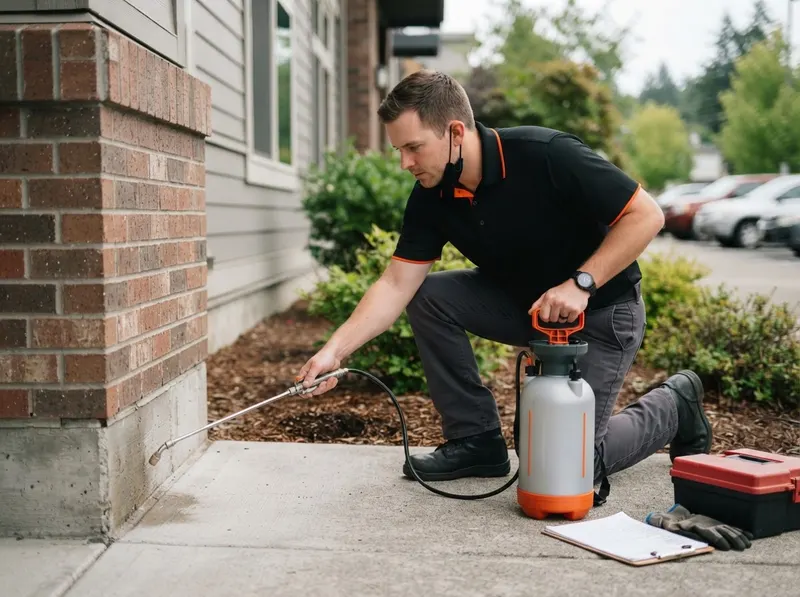
Eco-perimeter commercial pest maintenance prioritizes facility exterior envelopes, stopping insects and rodents before they breach sensitive interior zones like production floors, stockrooms, or customer areas. In Auburn's distinct damp lowland river climate, commercial buildings face unique structural pressures. Warehouses in the Terminal District and light industrial parks in North Auburn sit in flood-plain drainage pathways where high water tables force subterranean pests upward. Applying interior aerosol sprays inside active commercial kitchens or shipping bays contaminates surfaces and exposes employees to volatile organic compounds without stopping the outside population. By establishing an exterior defense line adhering to the EPA Integrated Pest Management principles, facility managers suppress active pest pathways while keeping operational environments free from synthetic chemical residue.
Commercial property footprints dictate specific service boundaries. Standard standalone retail storefronts along Riverwalk and near The Outlet Collection Seattle typically require a 3-foot vertical by 10-foot horizontal exterior liquid barrier zone combined with structural door-sweep adjustments under guidance from the Washington State University Extension Urban IPM Program. In contrast, large distribution centers near Emerald Downs and logistics facilities in the Stuck River Valley require perimeter gravel strips, vegetation clearing, and secured baiting perimeters conforming to OSHA commercial facility standards. The physical trade-off balances localized chemical exposure against exterior structural maintenance: prioritizing non-chemical exterior exclusion and micro-encapsulated natural oils requires consistent perimeter checks every 30 to 60 days, whereas older broadcast indoor chemical treatments introduce indoor air contaminants without correcting structural gaps.
Surrounding terrain across King County drives pest migration directly into commercial foundations. Logistics complexes along West Valley Highway and properties adjacent to the Green River encounter heavy rodent pressure from nearby wetland vegetation, particularly around Game Farm Wilderness Park Area and the Auburn Golf Course. Furthermore, commercial strip centers elevated on West Hill, Lea Hill, and the hillside properties of Lakeland Hills face dry-season nesting by western yellowjackets and sugar ants escaping hardened clay soils. Meeting environmental guidelines established by the Washington State Department of Agriculture, SilverNest Insect Control installs exterior tamper-resistant monitoring boxes anchored along foundation skirts, coupled with water-resistant granular botanical formulations that remain stable despite frequent Pacific Northwest precipitation. For facilities subject to routine safety assessments under the FDA Food Facility Good Manufacturing Practices, non-residual perimeter barriers ensure complete regulatory compliance without risking food-contact cross-contamination.
Operational protocols follow three distinct implementation stages. Step 1 begins with a physical transit map of the building envelope, measuring every service door, utility chase, and loading bay dock seal against guidelines from the CDC Environmental Health Services. Step 2 applies non-staining botanical micro-emulsions 12 inches up the foundation stem wall and 36 inches outward onto surrounding hardscapes or mulch, using essential botanical oil formulations registered under EPA Section 25b minimum risk exemptions. Step 3 seals exterior expansion joints and conduit voids larger than 6 millimeters using wire-reinforced structural silicone conforming to ASTM International building performance standards. This systematic sequence blocks entry pathways for commercial tenants across Auburn, maintaining protective physical boundaries between natural wetland habitats and commercial interiors.
Every job gets a firm, written price after a free on-site visit.
For standards, safe disposal, and service guidance on PEST CONTROL SEVICE in Auburn, WA, useful references include U.S. EPA, ENERGY STAR, U.S. Dept. of Energy, Consumer.gov, U.S. Census Bureau, and Google Maps. General consumer and small-business resources are available from USA.gov, Better Business Bureau, FTC Consumer Advice, U.S. Small Business Administration, and Ready.gov.
Tell us about your eco-perimeter commercial pest maintenance job in Auburn and we'll send a clear, written quote, usually the same day.
 SilverNest Insect Control